Workwear Manufacturers for Brands Building Tough Apparel
Cavela produces workwear, working with vetted workwear manufacturers and flame-resistant (FR) clothing manufacturers across our global factory network, spanning nine countries — China, India, Pakistan, Vietnam, Mexico, Turkey, Thailand, Bangladesh, and Egypt — managing fabric sourcing, certification verification, samples, and production end-to-end.


Our Products
What We Manufacture in Workwear
Workwear spans a wide range of protection levels and use cases, and the right factory depends heavily on which one you need. Here's what our network covers.

FR & Arc-Rated Clothing
Flame-resistant shirts, coveralls, and jackets built to meet NFPA 2112 and NFPA 70E requirements, typically constructed from inherently FR fabrics like modacrylic blends or treated cotton, used in oil and gas, electrical, and utility work environments.

High-Visibility Workwear
ANSI/ISEA 107-compliant hi-vis shirts, vests, and jackets in fluorescent fabrics with reflective taping, sized and constructed for layering over base garments in roadwork, construction, and warehouse settings.

Technical & Weather-Resistant Outerwear
Insulated jackets, rain shells, and softshell workwear built with waterproof or water-resistant membranes like Gore-Tex, DWR coatings, or PU laminates for outdoor and field-based crews.
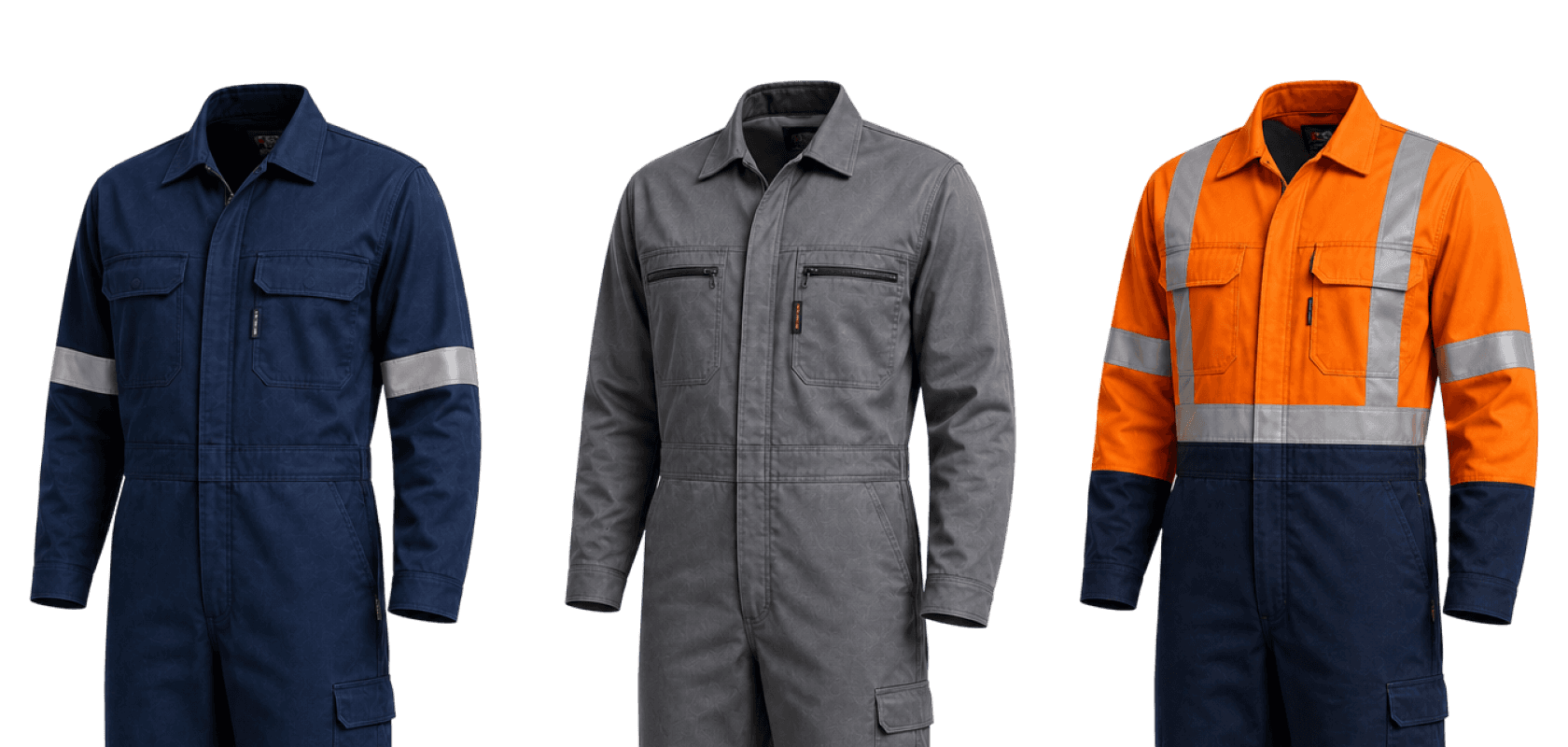
Industrial Coveralls & Uniforms
Durable coveralls, work pants, and branded uniform sets built from heavyweight cotton-poly blends or ripstop fabrics, reinforced at high-wear points like knees and elbows for daily industrial use.

Workwear Accessories
Tool belts, safety vests, hard hat accessories, and reinforced gloves that round out a full workwear line for brands supplying complete crew outfitting rather than single garments.

Custom Branded Workwear
Embroidered or printed uniform programs for companies outfitting their own crews, typically produced at higher volumes with consistent sizing and branding across every unit.
Across every category, fabric performance and certification accuracy matter more in workwear than almost any other apparel segment. A fabric that looks similar to a certified FR textile but lacks the actual treatment or weave is a problem you won't discover until it's tested. We match your product to factories with documented experience producing exactly the protection class you need, not factories simply willing to take the order.
How it works
Our Workwear Manufacturing Process
Workwear production carries more compliance weight than standard apparel, so our process is built around verification at every stage, not just construction quality.
Workwear is also where the cost of getting a supplier wrong is highest: a quality issue in a basic tee is a return, but a quality issue in FR clothing is a safety failure. That's why our oversight in this category goes deeper than standard apparel checks, from fabric lot verification through final inspection.
Resources
Additional Information
MOQs, Lead Times & Pricing Context
Minimums, lead times, and pricing in workwear depend heavily on protection class. Certified FR garments generally carry higher minimums and longer timelines than standard industrial uniforms or coveralls, because certified fabric runs are more involved and certified fabric mills often have their own production queues separate from the garment factory's. Brands outfitting their own crews under an ongoing uniform program can sometimes negotiate more favorable terms by ordering consistently across seasons. Pricing varies significantly by protection class: certified FR fabric costs meaningfully more per yard than standard workwear textiles, and arc-rated or multi-hazard garments more still. We negotiate directly with manufacturers and fabric suppliers on your behalf and confirm realistic numbers for your specific product upfront, so certification costs are visible from the start rather than discovered as a surprise later.
Certifications & Compliance
Workwear compliance isn't optional documentation: it's the entire reason the garment exists. Depending on your product and end-use environment, this typically includes NFPA 2112 (flame-resistant garments for flash fire protection), NFPA 70E (the workplace standard governing arc-rated clothing for electrical work), ANSI/ISEA 107 (high-visibility safety apparel), and OEKO-TEX Standard 100 for general fabric safety verification across non-FR workwear lines. Certification documentation needs to follow the actual fabric used in production, not just the fabric type in general. A factory using a certified fabric supplier doesn't guarantee every batch carries valid, current documentation. We verify certification paperwork at the fabric level before production starts and again before shipment, since gaps here create real liability exposure for workwear brands, not just a compliance headache. We work with factories and fabric mills that maintain current certifications and can help you confirm exactly which standards apply to your specific product and end-use case before you commit to a supplier.
Frequently Asked Questions
" height="202.14000011062623px" id="ynQRlKxgt" transform="translate(22.5 86)" width="605.8359880371094px"/><path d="M 118.092 0 C 192.432 0 233.65 48.13 233.65 115.133 C 233.653 123.281 232.97 131.414 231.609 139.447 L 54.47 139.447 C 56.814 172.485 72.568 193.905 97.401 202.14 L 21.282 202.14 C 7.568 181.759 0 155.888 0 126.062 C 0.001 50.12 48.363 0.001 118.092 0 Z M 118.092 44.663 C 82.981 44.664 59.574 64.516 54.981 103.705 L 182.225 103.705 C 178.159 65.511 155.772 44.663 118.092 44.663 Z" fill="rgb(255, 255, 255)" height="202.14px" id="g1XFYHGDH" transform="translate(615 86)" width="233.6500104835305px"/><path d="M 844.464 285.36 C 843.865 286.244 843.251 287.124 842.622 288 L 766.027 288 C 789.971 280.863 802.501 264.825 809.353 249.62 Z M 936.172 288 L 879.167 288 L 879.167 0 L 936.172 0 Z M 1069.27 85.86 C 1130.85 85.86 1165.47 120.109 1165.47 179.648 L 1165.47 270.467 C 1165.47 281.38 1169.55 284.863 1178.7 284.863 L 1194.49 284.863 L 1194.49 288 L 1112.06 288 C 1112.04 287.296 1112.03 286.582 1112.03 285.858 L 1112.03 267.979 C 1110.379 274.86 1108.065 281.565 1105.12 288 L 1080.73 288 C 1100.19 279.281 1112.02 262.032 1112.02 239.702 L 1112.02 213.896 L 1048.4 241.692 C 1027.01 251.113 1018.37 259.554 1018.37 271.96 C 1018.37 278.711 1020.65 284.17 1025.39 288 L 963.799 288 C 963.524 285.476 963.387 282.94 963.39 280.401 C 963.39 246.154 987.819 225.307 1028.03 209.916 L 1111.01 175.685 C 1108.97 151.371 1097.78 134.985 1063.67 134.984 C 1030.58 134.984 1004.62 153.842 990.369 179.15 L 956.262 139.463 C 975.604 113.657 1014.29 85.861 1069.27 85.86 Z M 1247.94 249.359 C 1254.15 243.304 1264.22 243.304 1270.43 249.359 L 1298.75 276.966 C 1301.87 280.011 1303.43 284.008 1303.41 288 L 1214.97 288 C 1214.95 284.008 1216.5 280.011 1219.62 276.966 Z M 10.688 30.483 C 78.104 30.483 124.579 64.25 145.979 122.43 L 101.342 154.406 C 91.782 109.527 63.542 78.016 11.147 78.016 C 7.307 78.016 3.592 78.179 0 78.498 L 0 30.78 C 3.559 30.581 7.123 30.482 10.688 30.483 Z" fill="rgb(255, 255, 255)" height="288.00000061035155px" id="G18g8G_GQ" width="1303.4102295004773px"/></g></svg>)