Cat Product Manufacturing for Pet Brands

Cavela manufactures private label and custom cat products across toys, beds and caves, breakaway collars, harnesses, scratchers, bowls, and carriers. We match your product to vetted factories in our network of 110 across nine countries, then manage sampling, safety testing, production, quality inspection, and freight. Built for pet brands launching a first line or scaling an existing catalog.

At a Glance

Cat Product Manufacturing at a Glance

The figures pet brands ask about most.

Typical MOQ: 500 to 2,000 units per SKU, soft goods at the lower end, molded and food-contact items at the higher end

Sample lead time: 2 to 4 weeks from spec confirmation

Production lead time: 5 to 9 weeks after sample approval

Core materials: Polyester fleece, velboa, PP fiber fill, sisal rope, corrugated cardboard, natural cotton, nylon webbing, stainless steel, ceramic, BPA-free plastic

Common certifications: ASTM F963, EN 71, OEKO-TEX Standard 100, FDA food contact, LFGB, California Proposition 65

Production countries: China, India, Pakistan, Vietnam, Mexico, Turkey, Thailand, Bangladesh, Egypt

Reorder lead time: 4 to 7 weeks once the factory relationship is established

Ranges vary by construction and volume. We confirm exact figures for your product before you commit.

Our Products

What We Manufacture in Cat Products

Cat products carry design constraints dog products do not: escape-resistant fit, breakaway safety hardware, and small-parts risk on almost every toy.

Cat Toys

Wand and teaser toys, kicker toys, crinkle and plush mice, rattle balls, tunnels, and catnip or silvervine-filled designs. Built from polyester fleece, velboa, natural cotton, and corrugated card, with fill and attachment methods specified for ingestion risk.

Specs and options
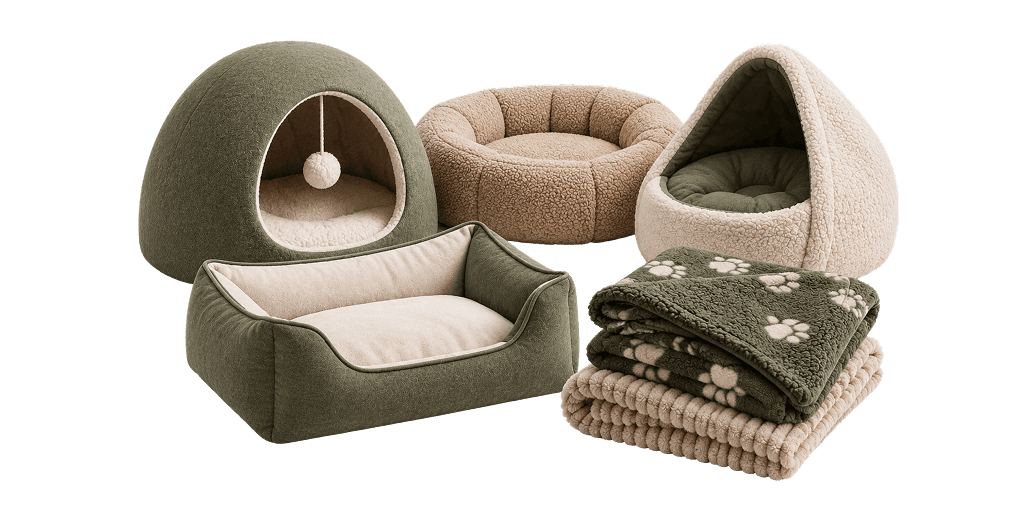
Cat Beds, Caves and Blankets

Enclosed cave beds, donut and bolster beds, radiator and window hammocks, crate mats, and throw blankets. Constructions in sherpa, fleece, felted wool, and canvas, with removable machine-washable covers across most of the range.

Specs and options

Cat Collars and Harnesses

Breakaway safety collars, decorative collars with bow or bell attachments, escape-resistant vest harnesses, and lightweight leads. Built on narrow nylon or recycled polyester webbing with breakaway buckles rated to release under load.

Specs and options

Cat Bowls and Feeding

Shallow wide bowls designed to reduce whisker contact, elevated and tilted stands, slow feeders, water fountains, and placement mats. Produced in stainless steel, ceramic, BPA-free plastic, and food-grade silicone.

Specs and options

Cat Scratchers and Furniture

Sisal-wrapped posts, corrugated cardboard scratchers and loungers, wall-mounted shelves, and multi-level towers. Built from sisal rope, recycled corrugated card, engineered board, and sustainably sourced wood.

Specs and options

Cat Carriers and Travel

Soft-sided carriers, backpack and bubble carriers, expandable travel crates, and car restraints. Structured builds in ripstop nylon and canvas with mesh ventilation panels, reinforced zips, and secondary safety tethers.

Specs and options

Most cat products fail on one of two things: a fit tolerance loose enough for a cat to escape, or a small component a cat can detach and swallow. We match each product to a factory with proven history in that construction rather than adapting a dog-product line to a smaller size.

How it works

Our Cat Product Manufacturing Process

Cat products carry a safety burden most consumer goods do not. A bell that detaches becomes an ingestion hazard, and a collar that fails to break away becomes a strangulation risk.

Product and Spec Review

1

We start with your design, reference samples, target retail price, and intended sales channel, then translate them into a spec sheet factories can quote against accurately.

What this looks in practice

Factory Matching

2

We match your product to factories within our network of 110 across nine countries, selecting for demonstrated experience in your specific construction type.

What this looks in practice

Sample Development and Safety Testing

3

We manage first-round samples and revisions, then run the testing your category requires: small-parts and attachment strength on toys, release tension on breakaway collars, restricted substances on food-contact items.

What this looks in practice

Transparent Quoting

4

Once your sample is approved we quote all-in pricing for your target order size, with no platform fee and no markup on the factory price.

What this looks in practice

Production & Onsite Quality Checks

5

We oversee bulk production with onsite inspections at defined checkpoints rather than a single final spot-check.

What this looks in practice

Logistics & Delivery

6

We handle freight forwarding, customs clearance, and delivery to your warehouse or 3PL, including tariff classification for pet products entering the US.

What this looks in practice

Fabric & Fit Specification

1

We start with your design, reference samples, target retail price, and intended sales channel, then translate them into a spec sheet factories can quote against accurately.

What this looks in practice

Factory Matching

2

We match your product to factories within our network of 110 across nine countries, selecting for demonstrated experience in your specific construction type.

What this looks in practice

Sample Development and Fit Testing

3

We manage first-round samples and revisions, then run the testing your category requires: small-parts and attachment strength on toys, release tension on breakaway collars, restricted substances on food-contact items.

What this looks in practice

Transparent Quoting

4

Once your sample is approved we quote all-in pricing for your target order size, with no platform fee and no markup on the factory price.

What this looks in practice

Production & Onsite Quality Checks

5

We oversee bulk production with onsite inspections at defined checkpoints rather than a single final spot-check.

What this looks in practice

Logistics & Delivery

6

We handle freight forwarding, customs clearance, and delivery to your warehouse or 3PL, including tariff classification for pet products entering the US.

What this looks in practice

The gap between approved sample and finished bulk is where most cat product runs go wrong: a supplier substitutes a weaker bell attachment, a breakaway buckle batch releases outside tolerance, or a sisal winder runs looser than the approved sample.

Resources

MOQs, Lead Times, and Pricing for Dog Products

Most cat products run between 500 and 2,000 units per SKU, soft goods at the lower end and molded or food-contact items higher. Sampling takes two to four weeks, production five to nine. Pricing tracks material and construction complexity more than quantity.

Typical ranges by product type

Toys, beds, blankets, scratchers: 500 to 1,000 units  |  7 to 12 weeks total  |  lower cost band

Collars, harnesses, carriers: 1,000 to 2,000 units  |  8 to 13 weeks total  |  mid cost band

Bowls, fountains, molded goods: 1,000 to 2,000 units  |  9 to 14 weeks total  |  higher cost band, tooling may apply

What moves your MOQ up or down

Molded products carry tooling costs that have to amortize across a run, which pushes minimums up. Custom fabric or webbing development raises them further. Colorway count multiplies the minimum, since most factories set MOQs per colorway rather than per style. Stock materials and single-colorway runs bring them down. Corrugated scratchers are the exception in this category: the tooling is a die rather than a mold, so minimums often sit below the rest of the range.

What moves your lead time

Stock materials ship in days; custom-developed fabric, webbing, or glaze adds two to four weeks before production can start. Each sample revision round adds roughly a week. Third-party safety testing adds one to two weeks. Catnip and silvervine sourcing is seasonal and can add lead time independent of the rest of the build. Chinese New Year and the pre-holiday peak from September to November extend everything.

What a quote includes

Unit cost, tooling or die amortization where applicable, retail packaging, QA inspection, and freight to your destination. Excluded: duties and tariffs, which vary by HTS classification and country of origin, and any third-party lab testing you commission independently. On scratchers, towers, and carriers we quote flat-pack and assembled separately, because freight volume drives landed cost more than unit price does.

Certifications

Certifications and Compliance for Dog Products

Cat products sold into US and EU retail need documented safety testing before most retailers or marketplaces will list them. Toys are tested to ASTM F963 and EN 71, bowls and fountains to FDA food-contact and LFGB, textiles to OEKO-TEX Standard 100.

ASTM F963

About this standard

EN 71

About this standard

OEKO-TEX Standard 100

About this standard

FDA Food Contact and LFGB

About this standard

California Proposition 65

About this standard

Factory Social Compliance

About this standard

We verify certification at material and component level before production begins, rather than accepting a blanket factory claim and finding the gap when a retailer requests documentation.

Choosing a manufacturer

How to Choose a Cat Product Manufacturer

Cat sourcing carries a risk most categories do not: a product that fails in use can injure an animal, and your brand carries that liability, not the factory.

Questions to ask before you commit

Have you produced this construction for cats specifically, not a scaled-down dog version? What release tension do your breakaway buckles test at, and do you test per batch or per order? How are bells, eyes, and feathers attached, and what pull force do they withstand? Which lab handles your safety testing? Is any part of this product subcontracted, and to whom? What is your defect rate on your last three runs of this product type?

Red flags to watch for

A quote that arrives within hours with no spec questions asked. Breakaway collars quoted without a release tension specification, which usually means the buckle is decorative rather than rated. Certificates naming a fabric mill or component supplier rather than the finished product. Refusal to accept onsite inspection. Pricing far below every other quote, which almost always means a material substitution you have not been told about. Pressure to skip a sample round to hit a ship date.

Domestic versus overseas for cat products

Domestic production genuinely wins on short runs under 250 units, on rapid restocks, and when made-in-USA is a stated part of your positioning. Overseas wins on unit economics at scale, on material variety, and on molded and hardware-intensive products where the tooling ecosystem is not domestic. Scratchers and towers are where this calculation flips most often, because freight on bulky low-value goods can erase the unit cost advantage entirely.

What to have ready before you reach out

A reference product or detailed sketch, target unit cost, target first order quantity, intended sales channel, and any certification your retailer or marketplace requires. A tech pack helps but is not required. The more specific you are on material and construction upfront, the fewer sample rounds you will need and the faster your quotes become comparable to each other.

Frequently Asked Questions

Cat Product Manufacturing FAQ

What is the minimum order quantity for custom cat products?

Most cat products run between 500 and 2,000 units per SKU, with soft goods at the lower end and molded or food-contact items at the higher end.

The driver is tooling and material commitment rather than sewing time. A plush mouse or a fleece blanket needs no mold and can often run at 500 units, sometimes lower on a first order with a factory that wants the relationship. A ceramic bowl or a molded fountain housing needs a mold cut before the first unit exists, and that cost has to amortize across the run, which pushes minimums toward 2,000. Corrugated scratchers sit apart from the rest of the category, because the tooling is a cutting die rather than a mold and costs a fraction as much. The variable that catches most brands out is colorway count: minimums are typically set per colorway, not per style, so a bed in three colors is three separate minimums.

Do cat collars need breakaway buckles?

For any collar worn unsupervised, yes. It is the single most important safety specification in the category.

Cats climb, squeeze through gaps, and catch collars on branches, fence posts, and furniture. A fixed buckle that would be appropriate on a dog becomes a strangulation risk on a cat, and most major retailers will not list an unsupervised-wear cat collar without one. The specification that matters is release tension: the force at which the buckle opens. Too high and it does not release when it needs to; too low and customers lose collars constantly and leave reviews about it. Ask any factory what tension their buckles release at and whether they test per batch or only per order. A breakaway buckle quoted with no tension specification is usually a decorative buckle, not a rated one. Harnesses and walking leads are the exception, since those are supervised-use products and need to hold.

What safety testing do cat products need?

It depends on the product and sales channel. Toys, food-contact items, textiles, and collars each carry their own standard.

Toys are typically tested to ASTM F963 in the US and EN 71 in the EU, covering small parts, attachment strength, and fill security. Cat toys sit at higher risk than dog equivalents here, because the components are small enough to be swallowed whole rather than choked on. Bowls, feeders, and fountains need FDA food-contact or LFGB testing, which examines stainless grade, glaze composition, and resin. Textiles for beds, caves, and blankets are tested to OEKO-TEX Standard 100. Breakaway collars should be release-tested with a documented tension range. California Proposition 65 applies on top if you sell into that state. We confirm which standards apply before quoting, because a compliance gap found after bulk is cut usually means scrapping the run.

How much does it cost to manufacture cat products?

Cost tracks material and construction complexity far more than quantity, and on bulky items freight can exceed unit price.

A crinkle mouse and a multi-level sisal tower are different orders of magnitude at identical volumes. Molded products carry a tooling cost on the first run that disappears on reorders, so a second order of a ceramic bowl is materially cheaper per unit. The factor specific to this category is freight volume. Scratchers, towers, and carriers are light but bulky, and container space rather than unit cost often determines landed price, which is why flat-pack engineering can matter more to your margin than negotiating the unit price down. We quote all-in with unit cost, tooling, packaging, inspection, and freight shown as separate lines, and on bulky goods we quote flat-pack and assembled side by side.

How is quality inspected during production?

Onsite inspections at defined checkpoints throughout the run, rather than a single spot-check on finished goods.

A final inspection catches problems when it is already too late to fix them cheaply. We inspect during production, which for cat products means attachment pull strength on bells, eyes, and feathers, breakaway buckle release tension sampled per batch rather than per order, fill weight consistency, glaze integrity and lead content on ceramics, and winding tension on sisal posts. Inspection follows AQL sampling, the standard method for deciding whether a lot passes based on a statistically valid sample rather than opening every carton. The checkpoint most factories skip is the handoff to a subcontractor. Printing, embroidery, and hardware are frequently done at a second facility, and that transfer is where components quietly get substituted.

How long does it take to manufacture a cat product?

Roughly seven to fourteen weeks from approved spec to delivered goods, depending on the product and your shipping method.

The sequence is sampling at two to four weeks, bulk production at five to nine weeks, then freight at three to six weeks by sea or five to ten days by air. Each sample revision round adds about a week, and most first products need at least one. Custom material development adds two to four weeks before production can begin, because the material has to exist before it can be cut or filled. Catnip and silvervine are worth flagging separately: both are seasonal crops, and sourcing can gate a toy launch independently of everything else in the build. Reorders are considerably faster, typically four to seven weeks, because the spec is settled and the tooling exists.

Can Cavela manufacture private label cat products for my brand?

Yes. Both private label and fully custom development are standard, and most brands use both across a catalog.

Private label means taking a proven factory design and making it yours through branding, materials, colorways, and packaging. It moves faster, carries lower minimums, and skips mold costs because the tooling already exists. Fully custom means developing from your own design and spec, which gives you a product no competitor can order from the same factory, but adds development time and tooling cost on molded goods. The practical path for most cat brands is private label on the first one or two SKUs to establish sell-through, then custom development on whatever proves out. Running private label bowls alongside a fully custom hero product is common and usually the right call on a limited budget.

Can you source and include catnip or silvervine?

Yes, in loose fill, sealed sachet, or refillable pouch formats, though both are seasonal crops.

Catnip potency varies considerably by harvest, growing region, and how long it has been stored, which is why two runs of the same toy can perform differently in the hands of a customer. Silvervine is increasingly popular because a meaningful share of cats do not respond to catnip at all, and it tends to work on some of those. Both are agricultural inputs subject to harvest timing, so a toy line built around them can be gated by crop availability rather than factory capacity. The practical decisions are potency grade, whether the fill is sealed inside the toy or refillable through a pouch, and how the product is packaged, since aroma degrades in open packaging on a retail shelf.

Which countries do you produce cat products in?

Across nine: China, India, Pakistan, Vietnam, Mexico, Turkey, Thailand, Bangladesh, and Egypt.

The right country depends on your product rather than your preference. China leads on molded goods, hardware, corrugated scratchers, and component variety, and for anything involving a mold or rated hardware it is usually the only serious answer at reasonable volumes. Vietnam and Bangladesh are strong on soft goods and cut-and-sew textiles, covering beds, caves, and blankets. India handles natural cotton and sisal products well. Mexico offers shorter transit into the US and different tariff treatment, which matters disproportionately on bulky categories where ocean freight is expensive. We match on construction type, certification needs, and landed cost target, and a multi-SKU catalog frequently runs across two or three.

We already work with a factory. Can Cavela help us switch?

Yes, and it is one of the most common reasons pet brands come to us.

We start by reviewing what you already have: existing specs, sample history, current unit costs, and the specific problem you are solving, whether that is quality inconsistency, communication breakdown, cost, or slipping lead times. That review matters, because a new factory is not always the right answer. Sometimes the issue is an under-specified spec sheet that any factory would interpret loosely, and moving it elsewhere reproduces the same result. If a switch is right, we match you with a better-fit factory and manage the transition, sampling against your existing product as the benchmark so you can compare like for like. The realistic timeline is one sampling cycle plus a production run, so plan around an inventory position that can absorb eight to twelve weeks.

What is the minimum order quantity for custom cat products?

Most cat products run between 500 and 2,000 units per SKU, with soft goods at the lower end and molded or food-contact items at the higher end.

The driver is tooling and material commitment rather than sewing time. A plush mouse or a fleece blanket needs no mold and can often run at 500 units, sometimes lower on a first order with a factory that wants the relationship. A ceramic bowl or a molded fountain housing needs a mold cut before the first unit exists, and that cost has to amortize across the run, which pushes minimums toward 2,000. Corrugated scratchers sit apart from the rest of the category, because the tooling is a cutting die rather than a mold and costs a fraction as much. The variable that catches most brands out is colorway count: minimums are typically set per colorway, not per style, so a bed in three colors is three separate minimums.

How long does it take to manufacture a cat product?

Roughly seven to fourteen weeks from approved spec to delivered goods, depending on the product and your shipping method.

The sequence is sampling at two to four weeks, bulk production at five to nine weeks, then freight at three to six weeks by sea or five to ten days by air. Each sample revision round adds about a week, and most first products need at least one. Custom material development adds two to four weeks before production can begin, because the material has to exist before it can be cut or filled. Catnip and silvervine are worth flagging separately: both are seasonal crops, and sourcing can gate a toy launch independently of everything else in the build. Reorders are considerably faster, typically four to seven weeks, because the spec is settled and the tooling exists.

Do cat collars need breakaway buckles?

For any collar worn unsupervised, yes. It is the single most important safety specification in the category.

Cats climb, squeeze through gaps, and catch collars on branches, fence posts, and furniture. A fixed buckle that would be appropriate on a dog becomes a strangulation risk on a cat, and most major retailers will not list an unsupervised-wear cat collar without one. The specification that matters is release tension: the force at which the buckle opens. Too high and it does not release when it needs to; too low and customers lose collars constantly and leave reviews about it. Ask any factory what tension their buckles release at and whether they test per batch or only per order. A breakaway buckle quoted with no tension specification is usually a decorative buckle, not a rated one. Harnesses and walking leads are the exception, since those are supervised-use products and need to hold.

Can Cavela manufacture private label cat products for my brand?

Yes. Both private label and fully custom development are standard, and most brands use both across a catalog.

Private label means taking a proven factory design and making it yours through branding, materials, colorways, and packaging. It moves faster, carries lower minimums, and skips mold costs because the tooling already exists. Fully custom means developing from your own design and spec, which gives you a product no competitor can order from the same factory, but adds development time and tooling cost on molded goods. The practical path for most cat brands is private label on the first one or two SKUs to establish sell-through, then custom development on whatever proves out. Running private label bowls alongside a fully custom hero product is common and usually the right call on a limited budget.

What safety testing do cat products need?

It depends on the product and sales channel. Toys, food-contact items, textiles, and collars each carry their own standard.

Toys are typically tested to ASTM F963 in the US and EN 71 in the EU, covering small parts, attachment strength, and fill security. Cat toys sit at higher risk than dog equivalents here, because the components are small enough to be swallowed whole rather than choked on. Bowls, feeders, and fountains need FDA food-contact or LFGB testing, which examines stainless grade, glaze composition, and resin. Textiles for beds, caves, and blankets are tested to OEKO-TEX Standard 100. Breakaway collars should be release-tested with a documented tension range. California Proposition 65 applies on top if you sell into that state. We confirm which standards apply before quoting, because a compliance gap found after bulk is cut usually means scrapping the run.

Can you source and include catnip or silvervine?

Yes, in loose fill, sealed sachet, or refillable pouch formats, though both are seasonal crops.

Catnip potency varies considerably by harvest, growing region, and how long it has been stored, which is why two runs of the same toy can perform differently in the hands of a customer. Silvervine is increasingly popular because a meaningful share of cats do not respond to catnip at all, and it tends to work on some of those. Both are agricultural inputs subject to harvest timing, so a toy line built around them can be gated by crop availability rather than factory capacity. The practical decisions are potency grade, whether the fill is sealed inside the toy or refillable through a pouch, and how the product is packaged, since aroma degrades in open packaging on a retail shelf.

How much does it cost to manufacture cat products?

Cost tracks material and construction complexity far more than quantity, and on bulky items freight can exceed unit price.

A crinkle mouse and a multi-level sisal tower are different orders of magnitude at identical volumes. Molded products carry a tooling cost on the first run that disappears on reorders, so a second order of a ceramic bowl is materially cheaper per unit. The factor specific to this category is freight volume. Scratchers, towers, and carriers are light but bulky, and container space rather than unit cost often determines landed price, which is why flat-pack engineering can matter more to your margin than negotiating the unit price down. We quote all-in with unit cost, tooling, packaging, inspection, and freight shown as separate lines, and on bulky goods we quote flat-pack and assembled side by side.

Which countries do you produce cat products in?

Across nine: China, India, Pakistan, Vietnam, Mexico, Turkey, Thailand, Bangladesh, and Egypt.

The right country depends on your product rather than your preference. China leads on molded goods, hardware, corrugated scratchers, and component variety, and for anything involving a mold or rated hardware it is usually the only serious answer at reasonable volumes. Vietnam and Bangladesh are strong on soft goods and cut-and-sew textiles, covering beds, caves, and blankets. India handles natural cotton and sisal products well. Mexico offers shorter transit into the US and different tariff treatment, which matters disproportionately on bulky categories where ocean freight is expensive. We match on construction type, certification needs, and landed cost target, and a multi-SKU catalog frequently runs across two or three.

How is quality inspected during production?

Onsite inspections at defined checkpoints throughout the run, rather than a single spot-check on finished goods.

A final inspection catches problems when it is already too late to fix them cheaply. We inspect during production, which for cat products means attachment pull strength on bells, eyes, and feathers, breakaway buckle release tension sampled per batch rather than per order, fill weight consistency, glaze integrity and lead content on ceramics, and winding tension on sisal posts. Inspection follows AQL sampling, the standard method for deciding whether a lot passes based on a statistically valid sample rather than opening every carton. The checkpoint most factories skip is the handoff to a subcontractor. Printing, embroidery, and hardware are frequently done at a second facility, and that transfer is where components quietly get substituted.

We already work with a factory. Can Cavela help us switch?

Yes, and it is one of the most common reasons pet brands come to us.

We start by reviewing what you already have: existing specs, sample history, current unit costs, and the specific problem you are solving, whether that is quality inconsistency, communication breakdown, cost, or slipping lead times. That review matters, because a new factory is not always the right answer. Sometimes the issue is an under-specified spec sheet that any factory would interpret loosely, and moving it elsewhere reproduces the same result. If a switch is right, we match you with a better-fit factory and manage the transition, sampling against your existing product as the benchmark so you can compare like for like. The realistic timeline is one sampling cycle plus a production run, so plan around an inventory position that can absorb eight to twelve weeks.

Proof

Cat Brands We Manufacture For

Product Name

Lorem ipsum dolor sit amet consectetur adipiscing elit aliquam eget nullam pellentesque curabitur cociis maecenas gestant.

Product Name

Lorem ipsum dolor sit amet consectetur adipiscing elit aliquam eget nullam pellentesque curabitur cociis maecenas gestant.

Product Name

Lorem ipsum dolor sit amet consectetur adipiscing elit aliquam eget nullam pellentesque curabitur cociis maecenas gestant.

Product Name

Lorem ipsum dolor sit amet consectetur adipiscing elit aliquam eget nullam pellentesque curabitur cociis maecenas gestant.

Product Name

Lorem ipsum dolor sit amet consectetur adipiscing elit aliquam eget nullam pellentesque curabitur cociis maecenas gestant.

Product Name

Lorem ipsum dolor sit amet consectetur adipiscing elit aliquam eget nullam pellentesque curabitur cociis maecenas gestant.

Start Manufacturing Your Cat Product Line

Whether you are producing a first run of cat toys or scaling a catalog of beds, collars, and scratchers, Cavela handles factory matching, sampling, safety testing, production, and freight. One point of contact, factory-direct pricing, no platform fee.

Cavela is a manufacturing partner with a network of 100+ factories. 

© 2026 Cavela. All rights reserved.

Cavela is a manufacturing partner with a network of 100+ factories. 

© 2026 Cavela. All rights reserved.

Cavela is a manufacturing partner with a network of 100+ factories. 

© 2026 Cavela. All rights reserved.

Cavela is a manufacturing partner with a network of 100+ factories. 

© 2026 Cavela. All rights reserved.