Cookware & Kitchenware Manufacturing Without the Guesswork
Kitchenware looks simple until you're the one managing material safety, finish consistency, and a factory that's never quite sure if “matte" means what you think it means.


Our Products
Kitchenware spans a wide mix of materials and finishing techniques, and getting it right depends on matching your product to a factory that actually specializes in that material. Here's where our network is strongest.

Cookware & Bakeware
Pots, pans, stockpots, sauté pans, and bakeware in stainless steel, aluminum, cast iron, or carbon steel, including pieces with ceramic or other applied coatings, where heat performance, weight balance, and coating durability all factor into the right factory match.

Cutting Boards & Prep Tools
Wood, bamboo, and composite cutting boards along with prep tools like cheese boards and serving boards, where material selection and finish (oiled, sealed, or food-safe coated) directly affect durability and feel.

Bar Tools & Drinkware Accessories
Cocktail shakers, bar sets, ice buckets, and related accessories typically built from stainless steel, with finishing options like brushed, matte, or plated affecting both look and unit cost.

Kitchen Utensils & Tool Sets
Wooden, silicone, or stainless utensil sets, often sold as branded collections, requiring consistent finish and handle construction across every piece in a multi-item set.
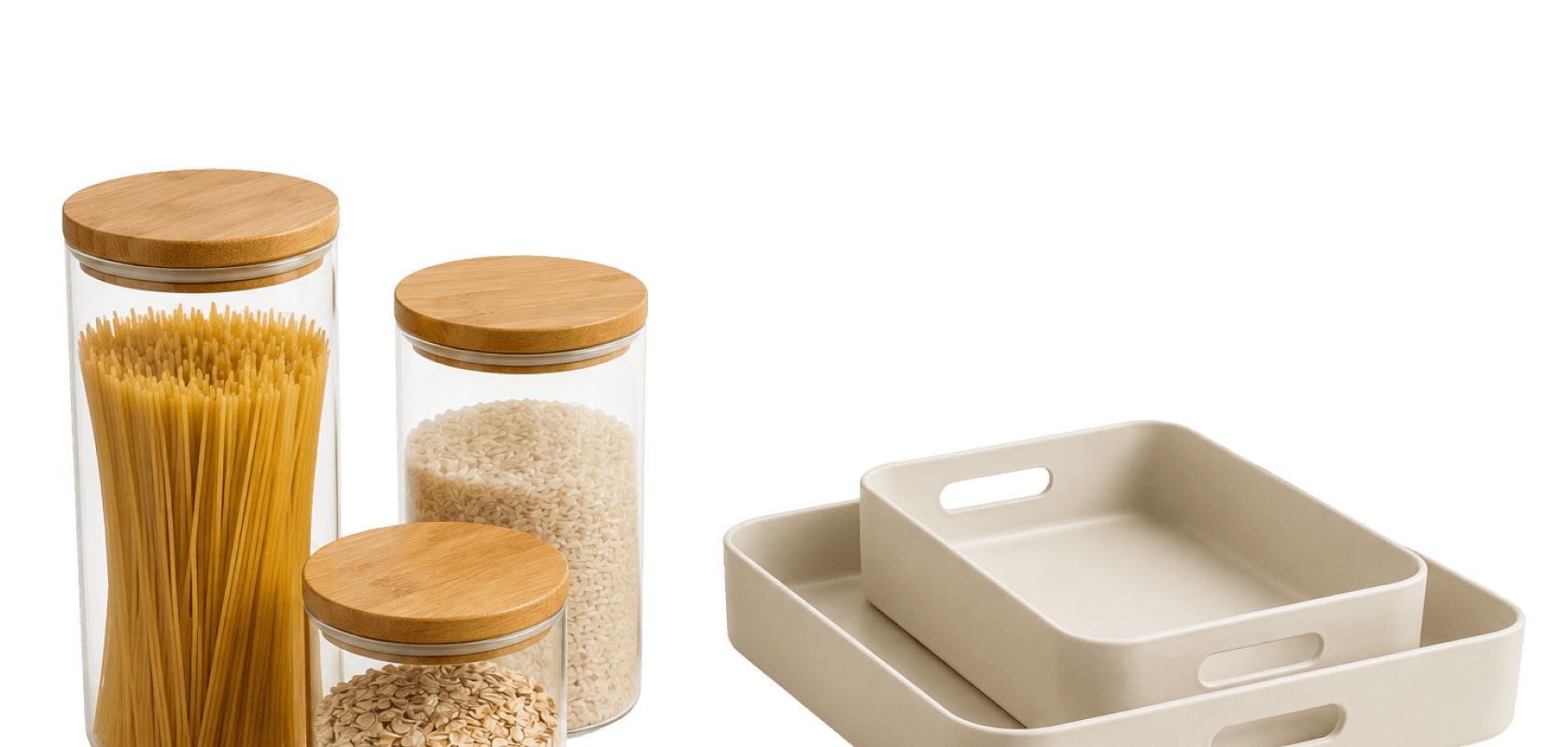
Storage & Organization Pieces
Canisters, trays, and organizational kitchenware built from wood, metal, or ceramic, where finish consistency across a full collection matters more than any single hero item.
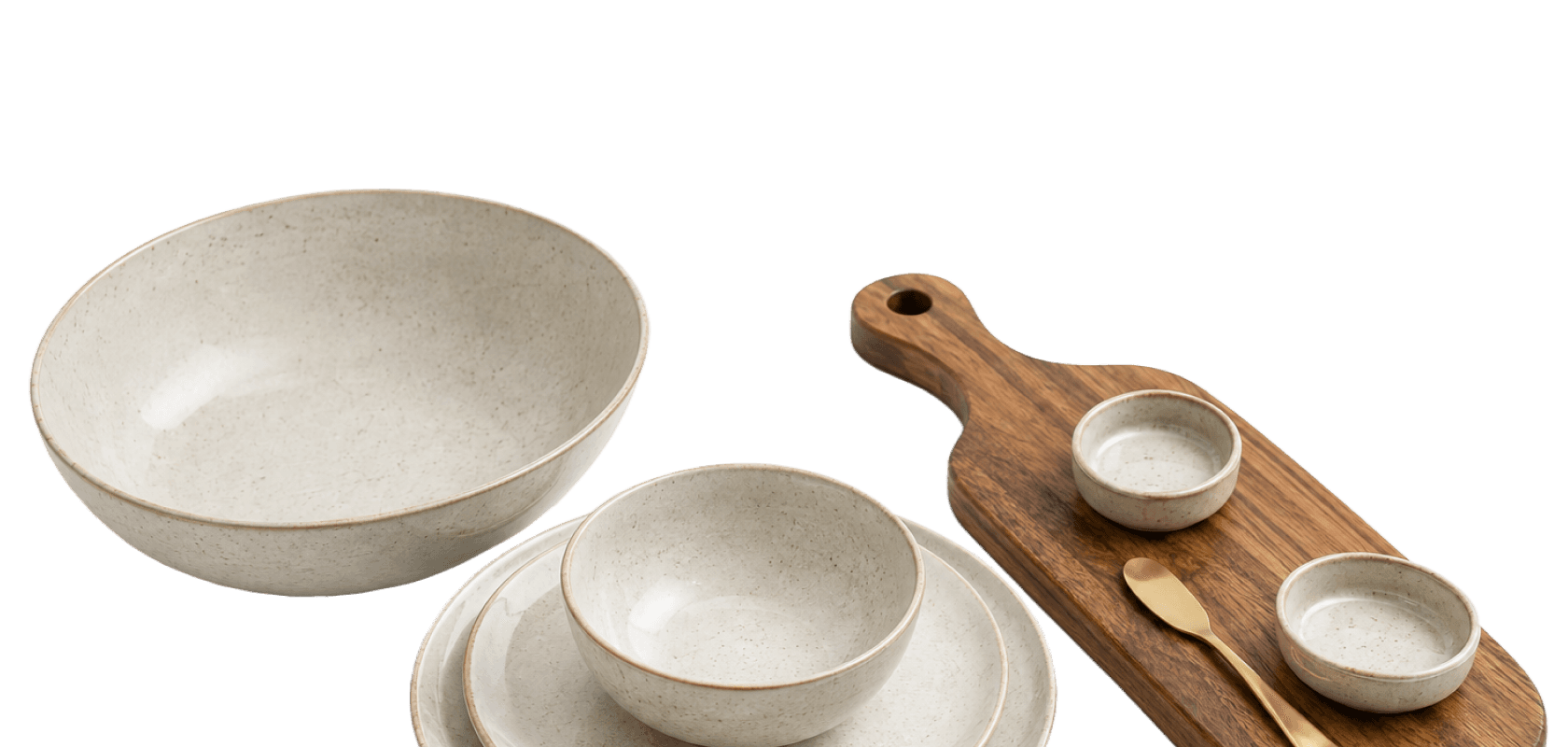
Serveware & Tabletop Pieces
Serving bowls, platters, and tabletop accessories that pair functional use with a design-forward finish, often produced alongside cookware, cutting boards, or bar tools as part of a broader home goods collection.
Material choice drives almost everything in kitchenware production. A factory skilled in wood cutting boards isn't necessarily equipped to deliver stainless cookware or bar tools at the same quality level, even if it's willing to quote both. We match your specific product and material to a factory with proven experience in exactly that combination.
How it works
Kitchenware production has its own set of failure points: finish inconsistency across a batch, food-safety compliance gaps, and material substitutions that aren't obvious until the product is in hand. Here's how we manage it.
Finish consistency is where kitchenware production most often goes wrong at scale. A sample with a beautiful oiled board or an evenly coated pan doesn't guarantee the same result across a full production run unless someone's checking for it. That's specifically what our onsite quality process is built to catch.
Resources
MOQs, Lead Times & Pricing Context
Minimums, lead times, and pricing in kitchenware depend heavily on material and complexity. Simple single-material pieces like wood cutting boards generally carry lower minimums than multi-piece sets, stainless bar-tool collections, or cookware that requires more involved tooling and finishing. Some factories will run smaller test orders for first-time brands, usually at a higher per-unit cost. Lead times depend on material availability and finish complexity: wood products with natural variation, or coated cookware that needs finish approval, sometimes need an extra sample round before bulk begins. Pricing tracks material and finishing method: solid wood costs more than composite or bamboo, plated or brushed stainless costs more than a basic matte finish, and cookware materials and coatings carry their own cost profile. We negotiate directly with manufacturers on your behalf and confirm realistic numbers for your specific product before you commit.
Certifications & Compliance
Kitchenware that contacts food directly carries safety requirements that don't apply to most other product categories. In the US, this typically means compliance with FDA food-contact material regulations, which cover materials like wood, silicone, and metal used in cutting boards, utensils, serveware, and cookware. The EU applies its own food-contact material framework under EC 1935/2004, which brands selling into European markets need to confirm separately from US requirements. Material-specific certifications also matter. Wood products are sometimes expected to carry FSC certification confirming responsibly sourced timber, while metal cookware, coated pans, and bar tools may need to demonstrate they're free from lead or other restricted substances, and coated cookware may require additional documentation on coating safety. Retailers and marketplaces increasingly run their own compliance checks on top of these baseline standards, particularly for products marketed toward food preparation or storage rather than purely decorative kitchenware. We verify food-contact safety documentation at the material sourcing stage, before production begins, and can help you confirm which certifications apply to your specific material and target market before committing to a factory. Catching a compliance gap before bulk production starts is a quick fix; catching it after units have already shipped to your warehouse is a far more expensive one.
Frequently Asked Questions
" height="202.14000011062623px" id="ynQRlKxgt" transform="translate(22.5 86)" width="605.8359880371094px"/><path d="M 118.092 0 C 192.432 0 233.65 48.13 233.65 115.133 C 233.653 123.281 232.97 131.414 231.609 139.447 L 54.47 139.447 C 56.814 172.485 72.568 193.905 97.401 202.14 L 21.282 202.14 C 7.568 181.759 0 155.888 0 126.062 C 0.001 50.12 48.363 0.001 118.092 0 Z M 118.092 44.663 C 82.981 44.664 59.574 64.516 54.981 103.705 L 182.225 103.705 C 178.159 65.511 155.772 44.663 118.092 44.663 Z" fill="rgb(255, 255, 255)" height="202.14px" id="g1XFYHGDH" transform="translate(615 86)" width="233.6500104835305px"/><path d="M 844.464 285.36 C 843.865 286.244 843.251 287.124 842.622 288 L 766.027 288 C 789.971 280.863 802.501 264.825 809.353 249.62 Z M 936.172 288 L 879.167 288 L 879.167 0 L 936.172 0 Z M 1069.27 85.86 C 1130.85 85.86 1165.47 120.109 1165.47 179.648 L 1165.47 270.467 C 1165.47 281.38 1169.55 284.863 1178.7 284.863 L 1194.49 284.863 L 1194.49 288 L 1112.06 288 C 1112.04 287.296 1112.03 286.582 1112.03 285.858 L 1112.03 267.979 C 1110.379 274.86 1108.065 281.565 1105.12 288 L 1080.73 288 C 1100.19 279.281 1112.02 262.032 1112.02 239.702 L 1112.02 213.896 L 1048.4 241.692 C 1027.01 251.113 1018.37 259.554 1018.37 271.96 C 1018.37 278.711 1020.65 284.17 1025.39 288 L 963.799 288 C 963.524 285.476 963.387 282.94 963.39 280.401 C 963.39 246.154 987.819 225.307 1028.03 209.916 L 1111.01 175.685 C 1108.97 151.371 1097.78 134.985 1063.67 134.984 C 1030.58 134.984 1004.62 153.842 990.369 179.15 L 956.262 139.463 C 975.604 113.657 1014.29 85.861 1069.27 85.86 Z M 1247.94 249.359 C 1254.15 243.304 1264.22 243.304 1270.43 249.359 L 1298.75 276.966 C 1301.87 280.011 1303.43 284.008 1303.41 288 L 1214.97 288 C 1214.95 284.008 1216.5 280.011 1219.62 276.966 Z M 10.688 30.483 C 78.104 30.483 124.579 64.25 145.979 122.43 L 101.342 154.406 C 91.782 109.527 63.542 78.016 11.147 78.016 C 7.307 78.016 3.592 78.179 0 78.498 L 0 30.78 C 3.559 30.581 7.123 30.482 10.688 30.483 Z" fill="rgb(255, 255, 255)" height="288.00000061035155px" id="G18g8G_GQ" width="1303.4102295004773px"/></g></svg>)